
How to Pray in Islam for Beginners
If you just became Muslim, start with the prayer whose time has come. Allah alone deserves our worship. We worship Him in prayer five times a day. The prayer is called “salah.”
A “rak‘ah” is one unit of prayer. This guide walks you through both units of “Fajr” and all four units of “Dhuhr.” You can start with the example you need.
فَٱعۡبُدۡنِي وَأَقِمِ ٱلصَّلَوٰةَ لِذِكۡرِيٓ
So worship Me ˹alone˺, and establish prayer for My remembrance.
Taha 20:14 (excerpt)
All Qur’an quotations in this article use Dr. Mustafa Khattab’s The Clear Quran.
Before your first prayer
- Check a prayer timetable for your city. “Fajr” is from true dawn until sunrise. “Dhuhr” starts after the sun passes its highest point.
- Make “wudu,” the wash for prayer. Wash your hands. Rinse your mouth and nose. Wash your face and arms up to and including your elbows. Wipe your head with wet hands. Wash your feet up to and including your ankles. Sahih al-Bukhari 164.
- Wear clean clothes and find a clean spot. A man can wear a shirt covering his shoulders and pants covering from his navel through his knees. A woman praying alone can wear loose, opaque clothes covering her body, hair and feet, with her face and hands uncovered. A clean floor works. The prayer mat can stay off your shopping list.
- Face the “qibla,” the direction of the “Ka‘bah” in Mecca. A “qibla” finder can help. In your heart, know which prayer you are about to pray for Allah.
The steps below are for praying on your own. Stand if you can. If you cannot stand, pray sitting. Sahih al-Bukhari 1117.

Photo by Zülfü Demir on Pexels.com.
If you are still learning the Arabic
You recite the Qur’an in Arabic during prayer. Start by listening to “Al-Fatihah”. Pause after each verse and say it back. Read the English meaning to understand what you are saying.
Keep praying on time while you learn. If you can recite part of the opening chapter or know another passage, use this guidance on what to recite. If you cannot recite any Qur’an and there is too little time left to learn before the prayer ends, say these words in the standing recitation for now. “Subhaanallaah, wal-hamdu lillaah, wa laa ilaaha illallaah, wallaahu akbar, wa laa hawla wa laa quwwata illaa billaah.”
Learn the other prayer phrases in Arabic too. If you are unable to say them in Arabic yet, most jurists allow you to say those phrases in your own language while you learn.
How to pray “Fajr” step by step
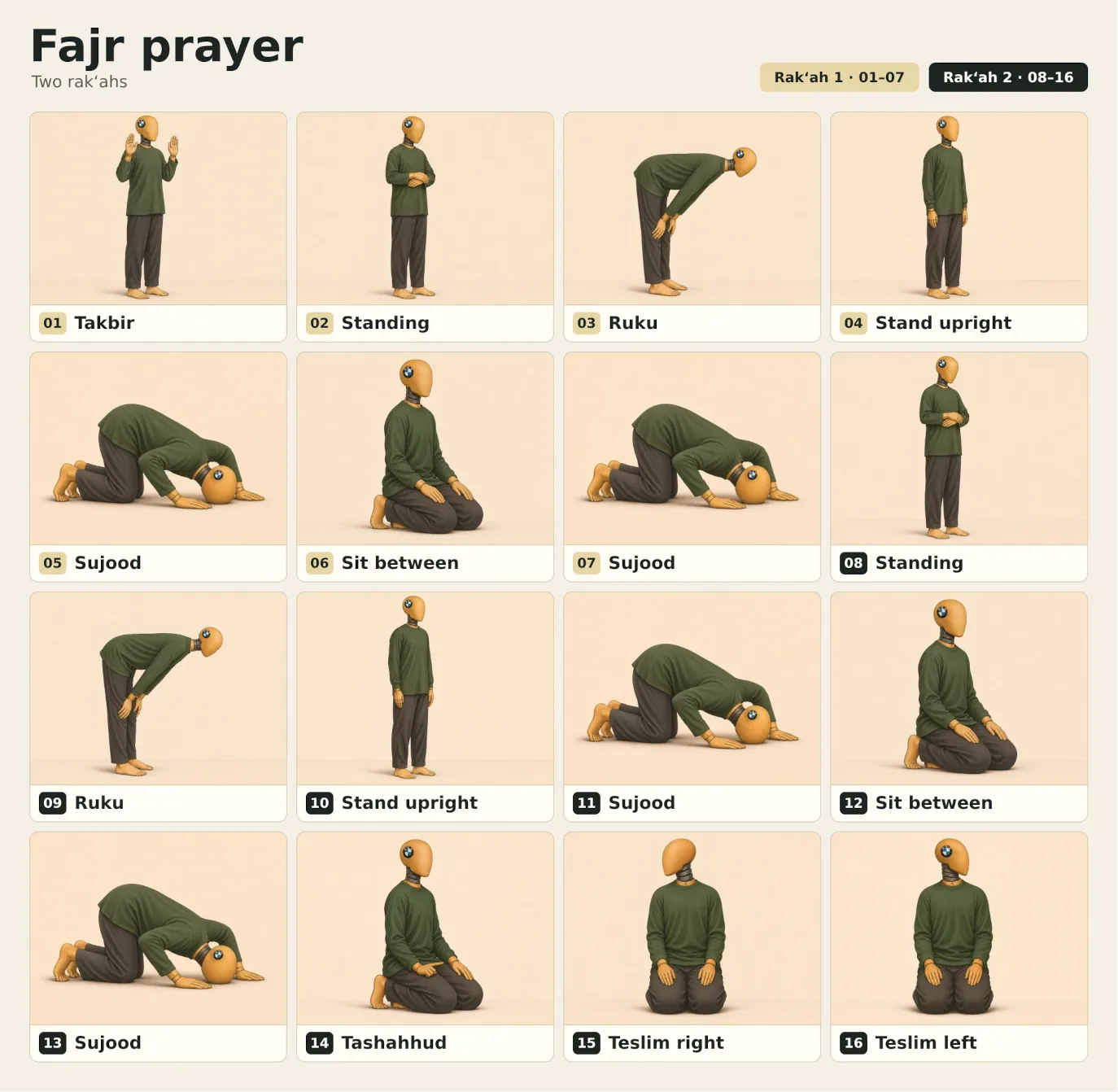
Follow positions 1–7 for the first “rak‘ah” and 8–16 for the second. Open the full-size picture. You may recite quietly if you pray “Fajr” alone.
Pause in each position. Prophet Muhammad ﷺ taught a man to settle into each movement before going to the next. Sahih al-Bukhari 757.
First “rak‘ah”
- Stand facing the “qibla.” Raise your hands to shoulder height and say “Allahu akbar” (Allah is the Greatest). Put your right hand over your left.
- Recite “Al-Fatihah” while standing. Then say “Aameen.”
- Say “Allahu akbar” and bow. Put your hands on your knees. Say “Subhaana rabbiyal-‘azeem” three times (Glory be to my Lord, the Most Great).
- Say “Sami‘allaahu liman hamidah” as you rise (Allah hears whoever praises Him). Stand straight. Say “Rabbanaa wa lakal-hamd” (Our Lord, all praise is Yours).
- Say “Allahu akbar” and go down for “sujood.” Rest your forehead, nose, palms, knees and toes on the floor. Say “Subhaana rabbiyal-a‘laa” three times (Glory be to my Lord, the Most High).
- Sit up while saying “Allahu akbar.” Pause and say “Rabbi ighfir lee.” This means “My Lord, forgive me.”
- Say “Allahu akbar” and go down again. Say “Subhaana rabbiyal-a‘laa” three times.
Second “rak‘ah”
- Say “Allahu akbar” as you stand. Place your right hand over your left in front of you. Recite “Al-Fatihah” and say “Aameen.”
- Say “Allahu akbar” and bow. Say “Subhaana rabbiyal-‘azeem” three times.
- Say “Sami‘allaahu liman hamidah” as you rise. Stand straight. Say “Rabbanaa wa lakal-hamd.”
- Say “Allahu akbar” and go down for “sujood.” Say “Subhaana rabbiyal-a‘laa” three times.
- Sit up while saying “Allahu akbar.” Pause and say “Rabbi ighfir lee.”
- Say “Allahu akbar” and go down again. Say “Subhaana rabbiyal-a‘laa” three times.
-
Say “Allahu akbar” and sit. Rest your hands on your thighs. Point forward with your right index finger as you recite the “tashahhud.”
Recite the “tashahhud,” the words of testimony you say while seated. Sahih al-Bukhari 831.
At-tahiyyaatu lillaahi was-salawaatu wat-tayyibaat.
As-salaamu ‘alayka ayyuhan-nabiyyu wa rahmatullaahi wa barakaatuh.
As-salaamu ‘alaynaa wa ‘alaa ‘ibaadillaahis-saaliheen.
Ash-hadu an laa ilaaha illallaah, wa ash-hadu anna Muhammadan ‘abduhoo wa rasooluh.
All greetings, prayers and good words belong to Allah. Peace be upon you, O Prophet, along with Allah’s mercy and blessings. Peace be upon us and on Allah’s righteous servants. I bear witness that Allah alone deserves worship and that Prophet Muhammad ﷺ is His servant and Messenger.
Stay seated and ask Allah to bless Prophet Muhammad ﷺ. Sahih al-Bukhari 3370.
Allaahumma salli ‘alaa Muhammadin wa ‘alaa aali Muhammadin, kamaa sallayta ‘alaa Ibraaheema wa ‘alaa aali Ibraaheem, innaka hameedun majeed.
Allaahumma baarik ‘alaa Muhammadin wa ‘alaa aali Muhammadin, kamaa baarakta ‘alaa Ibraaheema wa ‘alaa aali Ibraaheem, innaka hameedun majeed.
O Allah, honor Prophet Muhammad ﷺ and his family as You honored Prophet Ibrahim and his family. You are worthy of praise and full of glory. O Allah, bless Prophet Muhammad ﷺ and his family as You blessed Prophet Ibrahim and his family. You are worthy of praise and full of glory.
- Turn your head to the right. Say “As-salaamu ‘alaykum wa rahmatullaah” (Peace and Allah’s mercy be upon you).
- Turn your head to the left. Say “As-salaamu ‘alaykum wa rahmatullaah” again.
The two greetings end “Fajr.” They are called the “tasleem.” Sahih Muslim 582.
How to pray “Dhuhr” in four “rak‘ahs”
Pray “Dhuhr” quietly. Move your lips as you say the words. You sit after the second unit and again after the fourth. The greeting comes at the end of the fourth.
First “rak‘ah”
- Face the “qibla.” In your heart, intend to pray the four required units of “Dhuhr” for Allah.
- Stand upright. Raise your hands to shoulder height and say “Allahu akbar” (Allah is the Greatest). Rest your right hand over your left in front of you.
- Say “A‘oodhu billaahi minash-shaytaanir-rajeem” (I seek Allah’s protection from Satan). Recite “Al-Fatihah” and say “Aameen.” If you know a short chapter like “Al-Ikhlas”, you can recite it here.
- Bow. Say “Allahu akbar” as you bend. Put your hands on your knees. Keep your back level. Say “Subhaana rabbiyal-‘azeem” three times. It means “Glory be to my Lord, the Most Great.”
- Rise from the bow. Say “Sami‘allaahu liman hamidah” as you rise. Stand straight and pause. Say “Rabbanaa wa lakal-hamd.” You are saying that Allah hears the one who praises Him and that all praise is His.
- Go down for the first “sujood.” Say “Allahu akbar” as you move. Rest your forehead and nose on the floor. Both palms, both knees and the toes of both feet touch the floor too. Say “Subhaana rabbiyal-a‘laa” three times. It means “Glory be to my Lord, the Most High.”
- Sit up while saying “Allahu akbar.” Pause and say “Rabbi ighfir lee.” This means “My Lord, forgive me.” If you can, sit on your left foot and keep the right foot upright.
- Say “Allahu akbar” and go down for the second “sujood.” Rest your forehead, nose, palms, knees and toes on the floor. Say “Subhaana rabbiyal-a‘laa” three times.
Second “rak‘ah” and the first sitting
- Say “Allahu akbar” as you stand. Place your right hand over your left in front of you.
- Recite “Al-Fatihah” and say “Aameen.” You can then recite a short chapter you know.
- Bow. Say “Allahu akbar” as you bend. Put your hands on your knees. Keep your back level. Say “Subhaana rabbiyal-‘azeem” three times.
- Rise from the bow. Say “Sami‘allaahu liman hamidah” as you rise. Stand straight and pause. Say “Rabbanaa wa lakal-hamd.”
- Go down for the first “sujood.” Say “Allahu akbar” as you move. Rest your forehead and nose on the floor. Both palms, both knees and the toes of both feet touch the floor too. Say “Subhaana rabbiyal-a‘laa” three times.
- Sit up while saying “Allahu akbar.” Pause and say “Rabbi ighfir lee.”
- Say “Allahu akbar” and go down for the second “sujood.” Rest your forehead, nose, palms, knees and toes on the floor. Say “Subhaana rabbiyal-a‘laa” three times.
-
Say “Allahu akbar” as you sit. Rest your hands on your thighs and point with your right index finger. Recite the “tashahhud.” Sahih al-Bukhari 831.
At-tahiyyaatu lillaahi was-salawaatu wat-tayyibaat.
As-salaamu ‘alayka ayyuhan-nabiyyu wa rahmatullaahi wa barakaatuh.
As-salaamu ‘alaynaa wa ‘alaa ‘ibaadillaahis-saaliheen.
Ash-hadu an laa ilaaha illallaah, wa ash-hadu anna Muhammadan ‘abduhoo wa rasooluh.
All greetings, prayers and good words belong to Allah. Peace be upon you, O Prophet, along with Allah’s mercy and blessings. Peace be upon us and on Allah’s righteous servants. I bear witness that Allah alone deserves worship and that Prophet Muhammad ﷺ is His servant and Messenger.
When you finish these words, get ready to stand for the third unit.
Third “rak‘ah”
- Say “Allahu akbar” as you stand. Place your right hand over your left in front of you.
- Recite “Al-Fatihah” and say “Aameen.” This is enough recitation for this unit.
- Bow. Say “Allahu akbar” as you bend. Put your hands on your knees. Keep your back level. Say “Subhaana rabbiyal-‘azeem” three times.
- Rise from the bow. Say “Sami‘allaahu liman hamidah” as you rise. Stand straight and pause. Say “Rabbanaa wa lakal-hamd.”
- Go down for the first “sujood.” Say “Allahu akbar” as you move. Rest your forehead and nose on the floor. Both palms, both knees and the toes of both feet touch the floor too. Say “Subhaana rabbiyal-a‘laa” three times.
- Sit up while saying “Allahu akbar.” Pause and say “Rabbi ighfir lee.”
- Say “Allahu akbar” and go down for the second “sujood.” Rest your forehead, nose, palms, knees and toes on the floor. Say “Subhaana rabbiyal-a‘laa” three times.
Fourth “rak‘ah” and the final sitting
- Say “Allahu akbar” as you stand. Place your right hand over your left in front of you.
- Recite “Al-Fatihah” and say “Aameen.” This is enough recitation for this unit.
- Bow. Say “Allahu akbar” as you bend. Put your hands on your knees. Keep your back level. Say “Subhaana rabbiyal-‘azeem” three times.
- Rise from the bow. Say “Sami‘allaahu liman hamidah” as you rise. Stand straight and pause. Say “Rabbanaa wa lakal-hamd.”
- Go down for the first “sujood.” Say “Allahu akbar” as you move. Rest your forehead and nose on the floor. Both palms, both knees and the toes of both feet touch the floor too. Say “Subhaana rabbiyal-a‘laa” three times.
- Sit up while saying “Allahu akbar.” Pause and say “Rabbi ighfir lee.”
- Say “Allahu akbar” and go down for the second “sujood.” Rest your forehead, nose, palms, knees and toes on the floor. Say “Subhaana rabbiyal-a‘laa” three times.
-
Say “Allahu akbar” as you sit. Rest your hands on your thighs. Point with your right index finger while saying the “tashahhud.”
Recite the “tashahhud,” the words of testimony you say while seated. Sahih al-Bukhari 831.
At-tahiyyaatu lillaahi was-salawaatu wat-tayyibaat.
As-salaamu ‘alayka ayyuhan-nabiyyu wa rahmatullaahi wa barakaatuh.
As-salaamu ‘alaynaa wa ‘alaa ‘ibaadillaahis-saaliheen.
Ash-hadu an laa ilaaha illallaah, wa ash-hadu anna Muhammadan ‘abduhoo wa rasooluh.
All greetings, prayers and good words belong to Allah. Peace be upon you, O Prophet, along with Allah’s mercy and blessings. Peace be upon us and on Allah’s righteous servants. I bear witness that Allah alone deserves worship and that Prophet Muhammad ﷺ is His servant and Messenger.
Stay seated and ask Allah to bless Prophet Muhammad ﷺ. Sahih al-Bukhari 3370.
Allaahumma salli ‘alaa Muhammadin wa ‘alaa aali Muhammadin, kamaa sallayta ‘alaa Ibraaheema wa ‘alaa aali Ibraaheem, innaka hameedun majeed.
Allaahumma baarik ‘alaa Muhammadin wa ‘alaa aali Muhammadin, kamaa baarakta ‘alaa Ibraaheema wa ‘alaa aali Ibraaheem, innaka hameedun majeed.
O Allah, honor Prophet Muhammad ﷺ and his family as You honored Prophet Ibrahim and his family. You are worthy of praise and full of glory. O Allah, bless Prophet Muhammad ﷺ and his family as You blessed Prophet Ibrahim and his family. You are worthy of praise and full of glory.
Then ask Allah for protection before you finish. Sahih Muslim 588a.
Allaahumma innee a‘oodhu bika min ‘adhaabi Jahannam, wa min ‘adhaabil-qabr, wa min fitnatil-mahyaa wal-mamaat, wa min sharri fitnatil-maseehid-dajjaal.
You are asking Allah to protect you from Hell, punishment in the grave, the trials of life and death, and the trial of the False Messiah.
- Turn your head to the right. Say “As-salaamu ‘alaykum wa rahmatullaah” (Peace and Allah’s mercy be upon you).
- Turn your head to the left. Say “As-salaamu ‘alaykum wa rahmatullaah” again.
You have finished “Dhuhr.” Sahih al-Bukhari 776 describes the recitation in its first two and last two units. You can hear the prayer phrases in this guide.

Photo by David McEachan on Pexels.com.
How many “rak‘ahs” are in each daily prayer?
إِنَّ ٱلصَّلَوٰةَ كَانَتۡ عَلَى ٱلۡمُؤۡمِنِينَ كِتَٰبٗا مَّوۡقُوتٗا ١٠٣
Indeed, performing prayers is a duty on the believers at the appointed times.
An-Nisa 4:103 (excerpt)
- “Fajr” at dawn has two required units.
- “Dhuhr” after midday has four.
- “‘Asr” in the afternoon has four.
- “Maghrib” just after sunset has three.
- “‘Isha” at night has four.
Use the four-unit pattern for “‘Asr” and “‘Isha.” For “Maghrib,” do the final sitting after the third unit. In “Maghrib” and “‘Isha,” the “Sunnah” is to recite the Qur’an aloud in the first two units. Recite quietly in the later units. In “‘Asr,” all four are quiet.
If you are still learning how to become Muslim, you can hear the “shahada” spoken aloud. Guidance comes from Allah. Ask Him to help you pray. When the next prayer begins, use what you have learned and pray it on time.